REVIEW · SAVANNAH
90 Minutes Walking Tour in Savannah
Book on Viator →Operated by The Savannah Walking Tours · Bookable on Viator
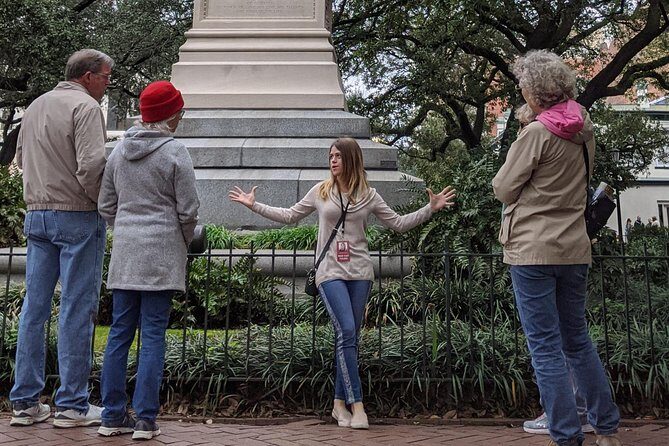
Savannah makes sense on foot. In 90 minutes, this guided walk stitches together key squares and landmarks so you understand how the city grew street by street. I like that the experience is guided by people such as Deborah and Andrew, who are praised for turning facts into an easy, conversational story.
Second, I love the focus on real places you can keep using after the tour. You hit major stops like Christ Church at Johnson Square and the Cathedral of St. John the Baptist, then finish at Forsyth Park for an obvious next step. Plus, the group stays small, with a maximum of 15 people, so the pace feels human.
One thing to plan for: there’s no food or drink provided, and the walk can run a little longer than the advertised time. Bring water for yourself, and wear shoes that handle a focused walking schedule.
In This Review
- Quick Hits
- A 90-Minute Savannah Walk That Actually Adds Up
- Getting Your Bearings at Johnson Square and Wright Square
- Colonial Park Cemetery and the Gordon House Museum: Two Kinds of Memory
- Chippewa Square to Madison Square: From Bus-Stop Pop Culture to Siege History
- Cathedral of St. John the Baptist: A Big Church With a Long Timeline
- Monterey Square: Pulaski, a Gothic Revival Synagogue, and a Famous House
- Ending at Forsyth Park for the Best Next Move
- Price and Timing: Is $30 Good Value for This Tour?
- What to Expect as You Walk: Pace, Questions, and Comfort
- Should You Book This Savannah Walking Tour?
- FAQ
- How much does the Savannah walking tour cost?
- How long is the tour?
- Where does the tour start?
- Where does the tour end?
- What language is the tour offered in?
- What is included in the tour price?
- Is food or drink included?
- Are there admission fees for the stops?
- How big is the group?
- Are service animals allowed?
- Can I get a full refund if I cancel?
Quick Hits
- Small group cap (15) keeps questions easy and the tour feel more personal.
- Mobile ticket means less fuss when you arrive at Johnson Square.
- Movie and Civil War stops show up in the middle of regular Savannah life, not in a separate museum setting.
- Church + cemetery + squares gives you a well-rounded sense of the city’s layers in only 90 minutes.
- Photo-friendly finish at Forsyth Fountain makes it simple to extend your day on your own.
A 90-Minute Savannah Walk That Actually Adds Up
Savannah can feel like a postcard. This tour helps it feel like a place with a timeline. You’re not just looking at pretty squares. You’re learning why each stop matters, and how multiple parts of the city connect through founding stories, battles, and famous residents.
The big value here is the time. Ninety minutes is short enough to fit into a busy day, but long enough for a real guide-led narrative. You start at Johnson Square and end at Forsyth Park, so you’re moving forward instead of doing a loop where you keep doubling back.
And because the group is limited to 15 travelers, the guide can slow down when a question pops up. That matters in a city where architecture, street names, and war history can turn into a word salad if nobody has the thread.
Other walking history tours in Savannah


Getting Your Bearings at Johnson Square and Wright Square
The tour begins at Johnson Square (2 E Bryan St), where you get a quick grounding in Savannah’s early identity. The guide introduces the square and brings in Christ Church, including its heritage and history. Even if you’re not a church-history person, this works because it explains why this area gets repeated as a starting point.
From there, you move to Wright Square, also called Court House Square. This stop is about power and order: it housed the first federal courthouse, the county courthouse, a jail, and burial grounds. That mix hits hard because it shows how the same blocks can hold justice, imprisonment, and remembrance in one breath.
A good thing about these two early stops is that they train your eye. By the time you’ve heard about Christ Church’s background and Wright Square’s courthouse-and-jail past, you start noticing how Savannah’s squares aren’t just scenic breaks. They’re built-in storyboards.
Colonial Park Cemetery and the Gordon House Museum: Two Kinds of Memory
Next up is Colonial Park Cemetery, Savannah’s colonial-era cemetery with an unusual story arc. You learn about its role in the Civil War and then the later movement connected to Savannah’s Victorian cemetery era. The guide doesn’t treat it like a static site. It comes across as a place people actively managed as history changed around them.
This is one of those stops where you’ll appreciate a guide. Cemeteries can be quiet and confusing without context. Here, the tour gives you the key threads—why it mattered during the Civil War, and how the cemetery’s place in town shifted later.
Then you’re pointed toward another powerful Savannah thread: a home linked to a strong woman of Savannah who was born, married, and died in Savannah. The Gordon family built and lived in the house, and the Girl Scouts later bought it and turned it into a museum. The tour also notes that all the Gordon children were born in this home, and that she’s the founder of the Girl Scouts of the USA.
Even if you don’t know the background, the logic works. You’re moving from wartime memory in the cemetery to a home-life story that became public history through the Girl Scouts museum. Two different kinds of remembrance, both tied to Savannah identity.
Chippewa Square to Madison Square: From Bus-Stop Pop Culture to Siege History
Chippewa Square is a fun pivot point because it mixes pop culture with real Savannah landmarks. You get the connection to Forrest Gump, specifically the scene where he waits for the bus on this square. Then the tour brings it back to local history with the statue in the center: General James Oglethorpe, described here as the founder of Savannah.
This stop is useful even if you’ve never seen the film. Why? Because it teaches you how Savannah’s squares became part of the story people tell about the city. You’ll walk away with a mental map of what’s instantly recognizable and why.
Then you head to Madison Square, where the focus is Sgt Jasper—he fought in the Siege of Savannah and was fatally wounded. The tour also points out St. Johns Episcopal Church in this square and the Green Meldrim house.
If you’re the type who usually skips war history, this is still worth it. The guide links the name on the monument to the siege events, so you’re not just reading a plaque. You understand what the moment represented for the city.
Cathedral of St. John the Baptist: A Big Church With a Long Timeline
One of the standout stops is the Cathedral of St. John the Baptist. The tour describes it as the largest and one of the most beautiful churches in Savannah. It’s a Catholic basilica that began as a church in the 1700s, while the actual basilica building was built in the mid-1800s.
That time span is the whole point. You’re seeing how Savannah changed while religious life stayed anchored. The guide’s approach helps you connect the early period to the later construction, instead of treating the cathedral like a single moment in time.
The tour notes that the cathedral is open daily, which is helpful if you want to return for a longer look after your walk. Even during the short stop here, you get enough context to know what you’re looking at when you come back.
Other walking tours we've reviewed in Savannah





Monterey Square: Pulaski, a Gothic Revival Synagogue, and a Famous House
Monterey Square adds another layer: names and battles. The square is named for the Battle of Monterey, and the tour highlights General Casimir Pulaski standing in the center of the square.
Then you get a strong architectural contrast with the tour’s mention of Mickve Israel, the synagogue on this square built in Gothic Revival style. That kind of detail matters because it trains you to see Savannah as more than one aesthetic. You’re looking at the same city answering different cultural needs through design.
The tour also brings in the Mercer Williams house. You learn it’s tied to the book Midnight in the Garden of Good & Evil and to movies filmed in Savannah. This is one of those stops where a guide helps you separate what’s famous from what’s actually meaningful in the setting.
You leave Monterey Square with a bigger sense of how stories travel. A battle produces names. A community builds a synagogue. Literature and film then borrow the same streets to tell newer stories.
Ending at Forsyth Park for the Best Next Move
The final stretch leads you into Forsyth Park, where the entrance brings you toward the famous Forsyth Fountain. This is the practical payoff of the tour: it ends at a place you can keep exploring without needing directions.
Forsyth Park is described as a 30-acre park and a meeting place for festivals, a farmers market, and restaurants. The tour also notes that there’s plenty of present-day information, plus lots of history behind the park.
In other words, it’s a smart finish line. When your guided time ends at Forsyth Fountain, you’re not stuck wondering what to do next. You’re already in a public space built for wandering, photo stops, and casual browsing.
Price and Timing: Is $30 Good Value for This Tour?
At $30 per person for about 90 minutes, the value depends on what you want from Savannah. If your goal is to get the highlights fast and understand what you’re looking at, this price-to-time ratio works well. You’re paying mainly for the guide’s storytelling and the structure of hitting multiple key sites in one walk.
A helpful detail for value: the stops are listed as admission ticket free, so you’re not constantly paying small add-ons as you go. The itinerary also has short stop times (about 10 minutes each), which keeps things moving without pretending you’ll see everything in a single pass.
On timing, there’s one honest consideration. Some people note that the tour can run slightly longer than advertised, and the reason given is the guide’s depth and attention to questions. If you’re on a tight schedule, you might plan a little buffer after the tour ends at Forsyth Park.
What to Expect as You Walk: Pace, Questions, and Comfort
This is a walking tour with a clear start and finish, not a sit-and-talk class. The guide moves you along and uses the route to explain connections between squares, people, and historic turning points.
Most travelers should be able to participate, and service animals are allowed. The tour also runs in English, and you’ll receive confirmation at booking. The tour uses a mobile ticket, so have your phone ready at the start.
For comfort, plan on a steady walking pace and a few brief standing moments at each stop. Since there’s no food or drink provided, you’ll want water for yourself, especially if you’re touring during warmer parts of the day.
Should You Book This Savannah Walking Tour?
Yes, if you want a quick, guided path through Savannah that helps you understand the city’s layers without spending half the day in transit. The biggest reason to book is the mix: courthouse square history, cemetery memory, a Girl Scouts museum home story, church scale, and multiple squares tied to battle, architecture, and pop culture.
Skip it only if you need a self-paced route with lots of free time per stop. This tour is designed for focused interpretation. You’ll leave knowing what the city is saying, not having hours to linger at every corner.
If your ideal Savannah day includes good context and a clean ending at Forsyth Park, this one fits neatly.
FAQ
How much does the Savannah walking tour cost?
The price is $30.00 per person.
How long is the tour?
The tour lasts about 1 hour 30 minutes, and the total duration includes travel time.
Where does the tour start?
The tour starts at Johnson Square, 2 E Bryan St, Savannah, GA 31401.
Where does the tour end?
The tour ends at Forsyth Park at Forsyth Fountain, Savannah, GA 31401.
What language is the tour offered in?
The tour is offered in English.
What is included in the tour price?
The tour includes the tour guide.
Is food or drink included?
No. No food or drink is provided.
Are there admission fees for the stops?
The stops listed are marked as admission ticket free, meaning you won’t be adding separate admission fees at those specific locations during the tour.
How big is the group?
The tour has a maximum of 15 travelers.
Are service animals allowed?
Yes. Service animals are allowed.
Can I get a full refund if I cancel?
Yes. You can cancel up to 24 hours in advance for a full refund.